Mississippi Grind (109 mins)
Directors: Ryan Fleck, Anna Boden
★ ★ ☆ ☆ ☆
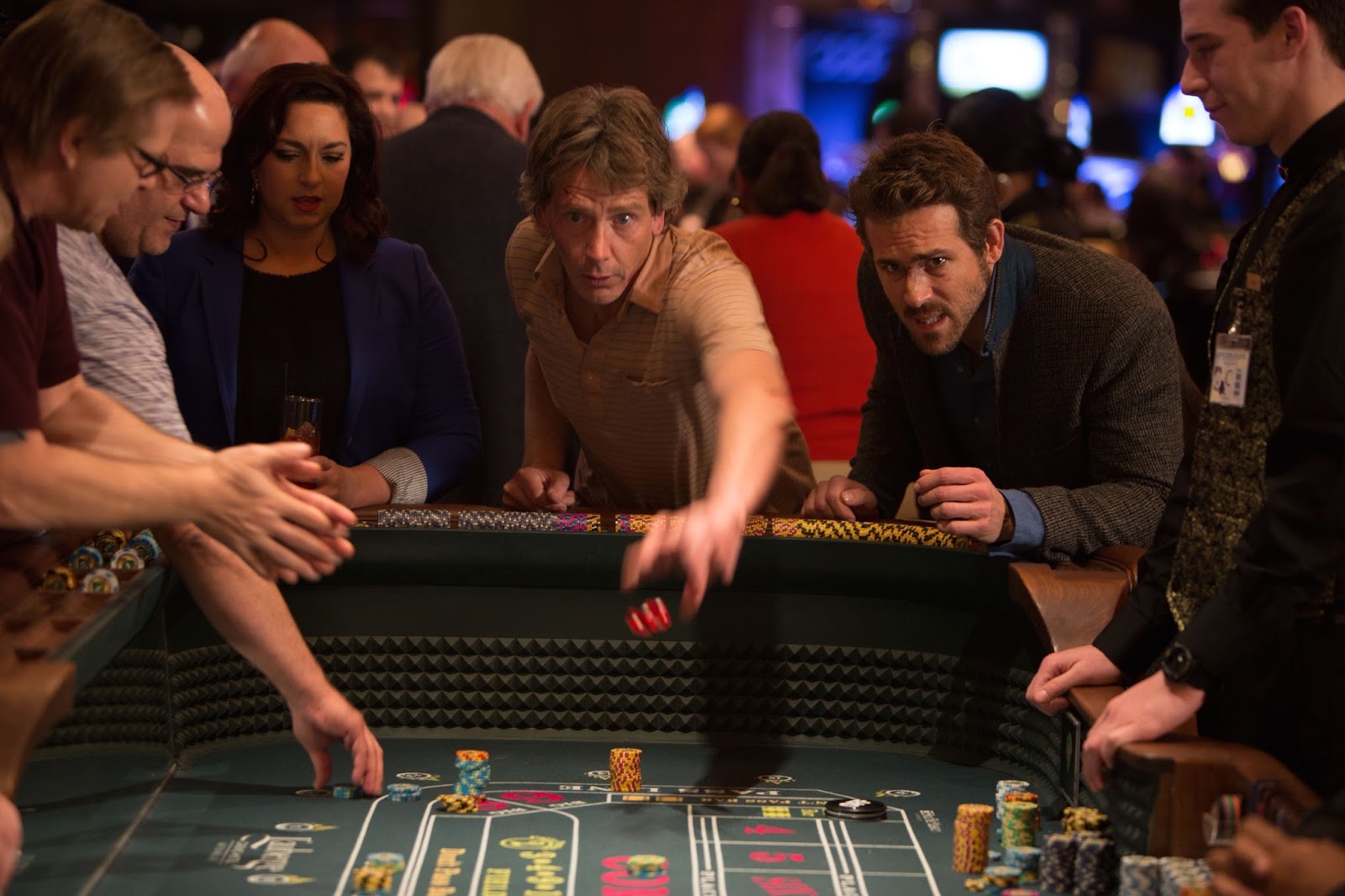
For the first few minutes there’s some promise in this gambling drama that displays a confident directorial style as sad-sack Ben Mendelsohn and fast-talking Ryan Reynolds meet at a poker table. Impressed with his new pal, Mendelsohn takes a shine to his style and they team up, travelling along the Mississippi to New Orleans, picking up whatever action they can along the way because, as is always the way with these things, Mendelsohn owes some money to some people. Reynolds talks and talks, telling stories like he’s Verbal from The Usual Suspects, and it seems like there are bound to be some intriguing developments down the line. But it starts to emerge that this is a story with nowhere to go, and no one particularly interesting to get us there. It never really makes it clear what the stakes are, so it’s not much more than a meander from one casino to the next. An air of desperation hangs over it, and that much glumness is fine if there’s a spark or a purpose, but Mississippi Grind largely drifts despite the best efforts of its leads.
Showing posts with label Drama. Show all posts
Monday, 5 October 2015
Zurich Film Festival - Mississippi Grind
Labels:
Ben Mendelsohn,
Drama,
Ryan Reynolds,
Zurich Film Festival
Tuesday, 29 September 2015
Zurich Film Festival - The Program
The Program (103 mins)
Director: Stephen Frears
★ ★ ★ ☆ ☆
The rise and fall of Lance Armstrong was fairly well covered a couple of years ago in Alex Gibney’s probing doc, The Armstrong Lie. But, just as The Walk from last week re-trod the ground of Man On Wire, here now is a dramatisation of those events that works reasonably as a companion piece.
Beginning in the mid 90s, Armstrong (Ben Foster) is the new kid on the cycling block, taking part in his first Tour De France and presenting us with an ambitious and determined individual. Everyone knows the winners dope so Armstrong approaches an Italian doctor asking to become part of his programme, where he’s administered a performance-enhancing drug called EPO.
Though fairly simplistic, the film does well to focus on the cycling and the attendant controversies, with Chris O’Dowd as the journalist who digs into the scandal of the endemic doping and the code of silence that protects a rancid sport and its riches.
The cycling footage gets right in amongst it, throwing in some archive stuff too to really get a sense of the crowds. It rattles through Armstrong’s cancer treatment and recovery while sensibly leaving out plenty of personal life material that could only have made this an even more functional biopic than it already is.
It also works by presenting several sides of Armstrong - the public adore him, and undoubtedly his charity work that raised millions for cancer research was a good thing. As a character he’s able to overcome the limitations of the film and Foster is very good, capturing well this persona of manipulation and self-belief. It’s those very flaws and contradictions in Armstrong that keep The Program interesting even if in many regards it’s A to B stuff. It’s by no means a great movie, but it’s about such a compelling man that by having this guy at its centre it more or less succeeds despite the uninspired filmmaking.
Director: Stephen Frears
★ ★ ★ ☆ ☆
The rise and fall of Lance Armstrong was fairly well covered a couple of years ago in Alex Gibney’s probing doc, The Armstrong Lie. But, just as The Walk from last week re-trod the ground of Man On Wire, here now is a dramatisation of those events that works reasonably as a companion piece.
Beginning in the mid 90s, Armstrong (Ben Foster) is the new kid on the cycling block, taking part in his first Tour De France and presenting us with an ambitious and determined individual. Everyone knows the winners dope so Armstrong approaches an Italian doctor asking to become part of his programme, where he’s administered a performance-enhancing drug called EPO.
Though fairly simplistic, the film does well to focus on the cycling and the attendant controversies, with Chris O’Dowd as the journalist who digs into the scandal of the endemic doping and the code of silence that protects a rancid sport and its riches.
The cycling footage gets right in amongst it, throwing in some archive stuff too to really get a sense of the crowds. It rattles through Armstrong’s cancer treatment and recovery while sensibly leaving out plenty of personal life material that could only have made this an even more functional biopic than it already is.
It also works by presenting several sides of Armstrong - the public adore him, and undoubtedly his charity work that raised millions for cancer research was a good thing. As a character he’s able to overcome the limitations of the film and Foster is very good, capturing well this persona of manipulation and self-belief. It’s those very flaws and contradictions in Armstrong that keep The Program interesting even if in many regards it’s A to B stuff. It’s by no means a great movie, but it’s about such a compelling man that by having this guy at its centre it more or less succeeds despite the uninspired filmmaking.
Labels:
Ben Foster,
Drama,
Stephen Frears,
Zurich Film Festival
Sunday, 23 June 2013
Hummingbird review
Hummingbird (15/R, 100 mins)
Director: Steven Knight
★ ★ ★ ☆ ☆
Jason Statham is Joey, a former special forces soldier now living rough on the streets of London. On the run from some heavies, Joey takes refuge in a rich guy’s apartment and when he discovers he’ll be out of town for several months, he takes on his identity and stays in the flat. Haunted by his experiences in Afghanistan, we learn about his past and why he’s hiding, as he strikes up a friendship with a Polish nun and gets mixed up with some gangsters along the way. The enigmatically titled Hummingbird (aka the rather more prosaic Redemption in the States) isn’t the usual Statham kick-fest, although he still gets to show some skills in the odd bit of action. He gets to emote too, something he’s proves perfectly capable of, but this is an odd concoction, part bleak drama about the underprivileged, part tale of an avenging angel. It’s a curious melange of plot threads, with no real surprise about how they fit together, but still kind of interesting and with enough action to keep Statham’s core fanbase amused.
Director: Steven Knight
★ ★ ★ ☆ ☆
Jason Statham is Joey, a former special forces soldier now living rough on the streets of London. On the run from some heavies, Joey takes refuge in a rich guy’s apartment and when he discovers he’ll be out of town for several months, he takes on his identity and stays in the flat. Haunted by his experiences in Afghanistan, we learn about his past and why he’s hiding, as he strikes up a friendship with a Polish nun and gets mixed up with some gangsters along the way. The enigmatically titled Hummingbird (aka the rather more prosaic Redemption in the States) isn’t the usual Statham kick-fest, although he still gets to show some skills in the odd bit of action. He gets to emote too, something he’s proves perfectly capable of, but this is an odd concoction, part bleak drama about the underprivileged, part tale of an avenging angel. It’s a curious melange of plot threads, with no real surprise about how they fit together, but still kind of interesting and with enough action to keep Statham’s core fanbase amused.
Labels:
Action,
British,
Drama,
Jason Statham
Thursday, 15 November 2012
The Master review
The Master (15/R, 143 mins)
Director: Paul Thomas Anderson
★ ★ ★ ☆ ☆
Paul Thomas Anderson’s long awaited new film, his first since the monumental There Will Be Blood five years ago, is a drifting, enigmatic thing that is bound to please some audiences more than others.
On the surface it’s a film about a cult which some have likened to Scientology, which may well be the case. It’s not really important. The sceptics do get a voice, but it’s not an attack on it, put it that way. Disappointingly, it never fully succeeds as character study either.
Anderson’s skill at conveying character through action rather than words does drive the early stages though, as we encounter Freddie (Joaquin Phoenix) just as the end of the Second World War brings his days in the navy to a close.
Something of an oddball, seemingly sex-obsessed and suffering from post traumatic stress disorder, he drifts from job to job in the years following the war, never sure what to do with himself and subject to bouts of rage.
Freddie likes to make his own hooch, almost as much as he likes to drink it. On the run after being accused of poisoning someone with it, he stows away on a boat in San Francisco bound for New York.
It’s here that me meets Lancaster Dodd, played by Anderson’s frequent collaborator, Philip Seymour Hoffman. Dodd describes himself as “a writer, a doctor, a nuclear physicist and a theoretical philosopher”, any of which may or may not be the truth, but what most certainly is true is what a powerful and magnetic figure he is.
He leads a group called The Cause, and claims he can explore a person’s past lives through time-travel hypnosis, and that through this he can cure cancer and mental illness. Dodd sees the lost soul in Freddie and sets about trying to initiate him into their ways, but Freddie’s erratic behaviour consistently comes between them.
Deliberately paced, The Master lacks the clarity of intent that made There Will Be Blood so memorable. Like that film it has at its core a man of power and ambition and great will, albeit one who is most likely a brain-washing charlatan. It takes a while to show its hand, if it ever does, but the presence of its actors keeps you watching, and the technical expertise with which it’s all put together is beyond reproach.
But the content is the key, and it’s here that The Master both triumphs and frustrates. In a second half that’s largely unchecked by narrative conventions, it jumps between scenes that don’t necessarily relate or follow on to what’s come before. It’s never dull, but nor does it ever grab you by the throat and force you to engage with it.
This is all the more exasperating because, in Hoffman, we’re watching one of the finest actors on the planet command the screen. Phoenix is almost as magnetic in an astonishing physical performance, hunched and gaunt, his face perpetually contorted in a Brando sneer. Their initial scenes together electrify, as Dodd probes the weaker man into revealing the details of his past.
But it loses its way somewhat in a midsection that feels aimless and a final third that becomes increasingly obtuse and unaccommodating, and in the end The Master is an occasionally stunning but more often than not maddening experience.
Director: Paul Thomas Anderson
★ ★ ★ ☆ ☆
Paul Thomas Anderson’s long awaited new film, his first since the monumental There Will Be Blood five years ago, is a drifting, enigmatic thing that is bound to please some audiences more than others.
On the surface it’s a film about a cult which some have likened to Scientology, which may well be the case. It’s not really important. The sceptics do get a voice, but it’s not an attack on it, put it that way. Disappointingly, it never fully succeeds as character study either.
Anderson’s skill at conveying character through action rather than words does drive the early stages though, as we encounter Freddie (Joaquin Phoenix) just as the end of the Second World War brings his days in the navy to a close.
Something of an oddball, seemingly sex-obsessed and suffering from post traumatic stress disorder, he drifts from job to job in the years following the war, never sure what to do with himself and subject to bouts of rage.
Freddie likes to make his own hooch, almost as much as he likes to drink it. On the run after being accused of poisoning someone with it, he stows away on a boat in San Francisco bound for New York.
It’s here that me meets Lancaster Dodd, played by Anderson’s frequent collaborator, Philip Seymour Hoffman. Dodd describes himself as “a writer, a doctor, a nuclear physicist and a theoretical philosopher”, any of which may or may not be the truth, but what most certainly is true is what a powerful and magnetic figure he is.
He leads a group called The Cause, and claims he can explore a person’s past lives through time-travel hypnosis, and that through this he can cure cancer and mental illness. Dodd sees the lost soul in Freddie and sets about trying to initiate him into their ways, but Freddie’s erratic behaviour consistently comes between them.
Deliberately paced, The Master lacks the clarity of intent that made There Will Be Blood so memorable. Like that film it has at its core a man of power and ambition and great will, albeit one who is most likely a brain-washing charlatan. It takes a while to show its hand, if it ever does, but the presence of its actors keeps you watching, and the technical expertise with which it’s all put together is beyond reproach.
But the content is the key, and it’s here that The Master both triumphs and frustrates. In a second half that’s largely unchecked by narrative conventions, it jumps between scenes that don’t necessarily relate or follow on to what’s come before. It’s never dull, but nor does it ever grab you by the throat and force you to engage with it.
This is all the more exasperating because, in Hoffman, we’re watching one of the finest actors on the planet command the screen. Phoenix is almost as magnetic in an astonishing physical performance, hunched and gaunt, his face perpetually contorted in a Brando sneer. Their initial scenes together electrify, as Dodd probes the weaker man into revealing the details of his past.
But it loses its way somewhat in a midsection that feels aimless and a final third that becomes increasingly obtuse and unaccommodating, and in the end The Master is an occasionally stunning but more often than not maddening experience.
Sunday, 27 May 2012
The Angels’ Share review
The Angels’ Share (15, 101 mins)
Director: Ken Loach
★ ★ ★ ★ ☆
Fresh from picking up one of the top prizes at the Cannes Film Festival, Ken Loach’s latest collaboration with Scottish screenwriter Paul Laverty is a raw, sparky and grimly funny comedy drama filmed and set in Glasgow.
It opens with a variety of reprobates up in court being sentenced, who are then brought together to paint halls and clean up graveyards as part of their community payback. One young man, Robbie (Paul Brannigan), has been spared jail by the skin of his teeth, and is required to do 300 hours of service.
He’s also about to become a father, though his girlfriend’s father has other ideas about his involvement, her family of thugs making it clear they want Robbie to have nothing to do with the baby.
We’re presented with an intriguing character in Robbie, one whom we’re asked to side with despite his criminal past. His violent temper is something he needs to learn to control, and in one particularly harrowing scene he’s shown the consequences of his actions, as the victim he assaulted describes the senseless attack.
It could have been easy for the audience to lose its sympathy for Robbie at this point, but this is a film about first impressions and second chances, and that chance is given to Robbie by Harry (John Henshaw), his community service coordinator.
Harry is mad keen on whisky, and when Robbie demonstrates a quick knack and knowledge for the water of life, Harry takes him and his pals on a tour of a distillery, the movie’s title referring to the amount of spirit, about 2%, that evaporates each year from the casks.
With fatherhood offering Robbie his last chance to pull his life together, the question is whether he can he use his whisky skills to make a better life for himself and his new family, or if his past will catch up to him.
Though it can sometimes seem like two different films, the chummy whisky comedy on one hand, and a dark and dangerous life of violence on the other, both elements come together successfully thanks to Laverty’s trademark salty and realistic dialogue that pulls no punches with its language, and Loach’s unfussy direction that allows the action to flow freely and naturally.
The authenticity of his casting also helps, with the roles filled largely by newcomers with lived-in faces. Truth be told, some of the actors do more convincing work when they're being asked to be their rough and ready selves, than when they're given lines of plot to recite, but for the most part everyone impresses.
The result is many fine moments, but perhaps just a hint of corner-cutting in the writing. It’s a bit of a leap for Robbie to go from ned to whisky loving expert, and it all gets wrapped up a bit too neatly and conveniently, which might be a problem if this were one of Loach’s more gritty dramas.
But it’s essentially a fairytale, a rather fanciful blend that succeeds partly because it’s so funny, but mostly because of the filmmaking skill brought to it by its director and writer.
Director: Ken Loach
★ ★ ★ ★ ☆
Fresh from picking up one of the top prizes at the Cannes Film Festival, Ken Loach’s latest collaboration with Scottish screenwriter Paul Laverty is a raw, sparky and grimly funny comedy drama filmed and set in Glasgow.It opens with a variety of reprobates up in court being sentenced, who are then brought together to paint halls and clean up graveyards as part of their community payback. One young man, Robbie (Paul Brannigan), has been spared jail by the skin of his teeth, and is required to do 300 hours of service.
He’s also about to become a father, though his girlfriend’s father has other ideas about his involvement, her family of thugs making it clear they want Robbie to have nothing to do with the baby.
We’re presented with an intriguing character in Robbie, one whom we’re asked to side with despite his criminal past. His violent temper is something he needs to learn to control, and in one particularly harrowing scene he’s shown the consequences of his actions, as the victim he assaulted describes the senseless attack.
It could have been easy for the audience to lose its sympathy for Robbie at this point, but this is a film about first impressions and second chances, and that chance is given to Robbie by Harry (John Henshaw), his community service coordinator.
Harry is mad keen on whisky, and when Robbie demonstrates a quick knack and knowledge for the water of life, Harry takes him and his pals on a tour of a distillery, the movie’s title referring to the amount of spirit, about 2%, that evaporates each year from the casks.
With fatherhood offering Robbie his last chance to pull his life together, the question is whether he can he use his whisky skills to make a better life for himself and his new family, or if his past will catch up to him.
Though it can sometimes seem like two different films, the chummy whisky comedy on one hand, and a dark and dangerous life of violence on the other, both elements come together successfully thanks to Laverty’s trademark salty and realistic dialogue that pulls no punches with its language, and Loach’s unfussy direction that allows the action to flow freely and naturally.
The authenticity of his casting also helps, with the roles filled largely by newcomers with lived-in faces. Truth be told, some of the actors do more convincing work when they're being asked to be their rough and ready selves, than when they're given lines of plot to recite, but for the most part everyone impresses.
The result is many fine moments, but perhaps just a hint of corner-cutting in the writing. It’s a bit of a leap for Robbie to go from ned to whisky loving expert, and it all gets wrapped up a bit too neatly and conveniently, which might be a problem if this were one of Loach’s more gritty dramas.
But it’s essentially a fairytale, a rather fanciful blend that succeeds partly because it’s so funny, but mostly because of the filmmaking skill brought to it by its director and writer.
Sunday, 11 September 2011
Tomboy review
Tomboy (U, 82 mins)
Director: Celine Sciamma
★ ★ ★ ★ ☆
Young Michael has just moved to a new Paris neighbourhood, and he quickly goes about making a bunch of new friends. But Michael is really Laure, and the longer she goes without revealing the truth, the more difficult it will be for them to accept her as a girl. It’s a simple setup for a wafer-thin but endearing drama, during which not a great deal actually happens, as the kids play and fight and do all the things that children do. But every one of them is a fully realised and very well drawn character, and it’s held together by the naturalistic work of all the fine young cast, though special mention should go to the quite wonderful film debut performance of Zoé Héran as Michael/Laure.
Director: Celine Sciamma
★ ★ ★ ★ ☆
Young Michael has just moved to a new Paris neighbourhood, and he quickly goes about making a bunch of new friends. But Michael is really Laure, and the longer she goes without revealing the truth, the more difficult it will be for them to accept her as a girl. It’s a simple setup for a wafer-thin but endearing drama, during which not a great deal actually happens, as the kids play and fight and do all the things that children do. But every one of them is a fully realised and very well drawn character, and it’s held together by the naturalistic work of all the fine young cast, though special mention should go to the quite wonderful film debut performance of Zoé Héran as Michael/Laure.
You Instead review
You Instead (15, 80 mins)
Director: David Mackenzie
★ ★ ☆ ☆ ☆
Filmed entirely at the T in the Park festival in 2010,
this underwhelming drama breaks into a story of sorts when a member of an
American band ends up handcuffed to a British girl for a night of incidents and
arguments that follows rom-com conventions. It’s a plot device you might see on
a children’s TV drama, and one that lends itself to little of interest. The
sheer scale of the endeavour makes it visually arresting, and it has a certain
grungy charm and a couple of moments of spontaneous fun, but mostly it’s just a
bunch of annoying people in the mud and rain. It’s not a film, it’s a companion
piece for festivalgoers, an experiment to see if a movie can be shot in a
couple of days. In that regard, at least it’s been proven that it can’t.
Labels:
British,
Drama,
Rom-com,
You Instead
Wednesday, 29 June 2011
Larry Crowne review
Larry Crowne (12A/PG-13, 98 mins)
Director: Tom Hanks
★ ★ ★ ☆ ☆
Tom Hanks marks his second time out as director with this throwaway comedy drama, co-writing with Nia Vardalos of My Big Fat Greek Wedding fame. Hanks also stars as Larry Crowne, a department store worker and model employee who is let go because he doesn’t have a college education. Recently divorced, unable to find another job, and with negative equity on his house, he decides his only recourse is to go back to college where one of his tutors turns out to be Julia Roberts. Leaving aside the similarities to the episode of Family Guy where Peter is passed over from promotion because he hadn’t finished the third grade, this is a breezy and charming, if paper thin confection that features very little interaction between its two stars during the early stages and too many incidental characters. It’s lightly comical without aiming for especially funny, but some shoddy physical gags let it down, and with its modest budget and ambitions, it’s far from the superstar vehicle suggested, though both Hanks and Roberts remain highly watchable.
Director: Tom Hanks
★ ★ ★ ☆ ☆
Tom Hanks marks his second time out as director with this throwaway comedy drama, co-writing with Nia Vardalos of My Big Fat Greek Wedding fame. Hanks also stars as Larry Crowne, a department store worker and model employee who is let go because he doesn’t have a college education. Recently divorced, unable to find another job, and with negative equity on his house, he decides his only recourse is to go back to college where one of his tutors turns out to be Julia Roberts. Leaving aside the similarities to the episode of Family Guy where Peter is passed over from promotion because he hadn’t finished the third grade, this is a breezy and charming, if paper thin confection that features very little interaction between its two stars during the early stages and too many incidental characters. It’s lightly comical without aiming for especially funny, but some shoddy physical gags let it down, and with its modest budget and ambitions, it’s far from the superstar vehicle suggested, though both Hanks and Roberts remain highly watchable.
Labels:
Comedy,
Drama,
Julia Roberts,
Larry Crowne,
School,
Tom Hanks
Monday, 22 November 2010
London Boulevard review
London Boulevard (18, 103 mins)
Director: William Monahan
★ ☆ ☆ ☆ ☆
London hard-man Mitchell (Colin Farrell) has just been released from prison when he is hired as a minder cum handyman for Charlotte (Keira Knightley), a world-famous but semi-retired actress. As a constant target for paparazzi, she lives practically as a recluse, and Mitchell divides his time between her home and trying to avoid the attentions of the local crime lord (Ray Winstone, naturally) who sees big things in him. This latter aspect provides passing interest in a very sub-Carlito’s Way manner, but when the screen is given over to the impossible to swallow romance between Mitchell and Charlotte, London Boulevard attains school play levels of badness. Whether it’s the dreadful dialogue, the complete lack of characterisation in their non-existent relationship or the amateur hour acting from an unusually stiff Knightley and deer-in-headlights Farrell, the result is less a movie than a flimsily connected patchwork of scenes, many of which look as though they were shot without the benefit of a director.
Director: William Monahan
★ ☆ ☆ ☆ ☆
London hard-man Mitchell (Colin Farrell) has just been released from prison when he is hired as a minder cum handyman for Charlotte (Keira Knightley), a world-famous but semi-retired actress. As a constant target for paparazzi, she lives practically as a recluse, and Mitchell divides his time between her home and trying to avoid the attentions of the local crime lord (Ray Winstone, naturally) who sees big things in him. This latter aspect provides passing interest in a very sub-Carlito’s Way manner, but when the screen is given over to the impossible to swallow romance between Mitchell and Charlotte, London Boulevard attains school play levels of badness. Whether it’s the dreadful dialogue, the complete lack of characterisation in their non-existent relationship or the amateur hour acting from an unusually stiff Knightley and deer-in-headlights Farrell, the result is less a movie than a flimsily connected patchwork of scenes, many of which look as though they were shot without the benefit of a director.
Labels:
British,
Colin Farrell,
Crime,
Drama,
Gangsters,
Keira Knightley,
London Boulevard,
Ray Winstone
Monday, 18 October 2010
The Arbor review
The Arbor (15, 94 mins)
Director: Clio Barnard
★ ★ ☆ ☆ ☆
The Arbor is the name given to a street on the Bradford housing estate that was home to the late playwright Andrea Dunbar, and this documentary consists mainly of her daughters recalling their troubled upbringing both before and after her death in 1990. It’s a film that works well when showing actual footage shot in the 80s, but the device of having actors lip-synching over the real people’s speech is one that distracts. Why not simply show the people themselves speaking or else have actors re-enact their words? This halfway house may be a novel approach but there’s more than a whiff of Nick Park’s Creature Comforts about it, and that coupled with the unrelenting grimness makes The Arbor something of a chore.
Director: Clio Barnard
★ ★ ☆ ☆ ☆
The Arbor is the name given to a street on the Bradford housing estate that was home to the late playwright Andrea Dunbar, and this documentary consists mainly of her daughters recalling their troubled upbringing both before and after her death in 1990. It’s a film that works well when showing actual footage shot in the 80s, but the device of having actors lip-synching over the real people’s speech is one that distracts. Why not simply show the people themselves speaking or else have actors re-enact their words? This halfway house may be a novel approach but there’s more than a whiff of Nick Park’s Creature Comforts about it, and that coupled with the unrelenting grimness makes The Arbor something of a chore.
Labels:
Andrea Dunbar,
British,
Documentary,
Drama,
The Arbor
Carlos review
Carlos (15, 165 mins)
Director: Olivier Assayas
★ ★ ☆ ☆ ☆
There’s a disclaimer at the beginning of Carlos stating that much of what is to follow is fictionalised. Given that, you may have had a right to expect something a good deal more involving than this plodding account of the career of Venezuelan terrorist Ilich Ramírez Sánchez, aka Carlos the Jackal.
From being recruited in 1973 to his arrest and imprisonment in the 90s, we follow his reign of assassinations and bombings throughout Europe, with Saddam Hussein numbering among his fans and associates. His goal is a campaign of terror to unite revolutionary groups around the world and his notoriety turns him into a celebrity, but it’s never demonstrated just why this is.
As presented here, Carlos is a far from compelling central character who proves himself to be nothing but a lot of talk and a gun. He may start out as charismatic but our interest wanes as the film progresses and he never proves himself to be particularly skilled or useful. One scene where he has to plead with his Lebanese boss that he can do better if given the chance plays like something from The Apprentice.
Like the very similar Baader Meinhof Complex before it, the problem is that for all its style and technical bravura, the film is nothing more than a sprawling collection of incidents, throwing around a lot of historical names and events to little effect.
A solid, but not revelatory turn from Édgar Ramírez in the title role lifts some of the burden, and he impresses whether speaking his dialogue in English, Spanish, French or Arabic. But with most of the characters speaking English most of the time, quite a few of the foreign actors struggle to give convincing performances.
A lengthy hostage sequence in the middle eats up a good portion of the running time but gets us nowhere and for the most part it’s a bit of a slog. At two and three quarter hours, this is the short version, with those who can stomach it able to seek out the full five and a half hour cut made for French television if they so wish.
But for all that spending the same amount of time again in this company sounds like a cinematic nightmare, it may fill in a lot of holes and prove to be more cohesive than this version, particularly in an extremely choppy final hour that consists almost entirely of Carlos moving from country to country looking for sanctuary or being struck down with mysterious ailments without explanation.
Ultimately your appreciation of Carlos may depend a great deal on how you feel about watching terrorists in silly hats sitting around talking about Leninism.
Director: Olivier Assayas
★ ★ ☆ ☆ ☆
There’s a disclaimer at the beginning of Carlos stating that much of what is to follow is fictionalised. Given that, you may have had a right to expect something a good deal more involving than this plodding account of the career of Venezuelan terrorist Ilich Ramírez Sánchez, aka Carlos the Jackal.From being recruited in 1973 to his arrest and imprisonment in the 90s, we follow his reign of assassinations and bombings throughout Europe, with Saddam Hussein numbering among his fans and associates. His goal is a campaign of terror to unite revolutionary groups around the world and his notoriety turns him into a celebrity, but it’s never demonstrated just why this is.
As presented here, Carlos is a far from compelling central character who proves himself to be nothing but a lot of talk and a gun. He may start out as charismatic but our interest wanes as the film progresses and he never proves himself to be particularly skilled or useful. One scene where he has to plead with his Lebanese boss that he can do better if given the chance plays like something from The Apprentice.
Like the very similar Baader Meinhof Complex before it, the problem is that for all its style and technical bravura, the film is nothing more than a sprawling collection of incidents, throwing around a lot of historical names and events to little effect.
A solid, but not revelatory turn from Édgar Ramírez in the title role lifts some of the burden, and he impresses whether speaking his dialogue in English, Spanish, French or Arabic. But with most of the characters speaking English most of the time, quite a few of the foreign actors struggle to give convincing performances.
A lengthy hostage sequence in the middle eats up a good portion of the running time but gets us nowhere and for the most part it’s a bit of a slog. At two and three quarter hours, this is the short version, with those who can stomach it able to seek out the full five and a half hour cut made for French television if they so wish.
But for all that spending the same amount of time again in this company sounds like a cinematic nightmare, it may fill in a lot of holes and prove to be more cohesive than this version, particularly in an extremely choppy final hour that consists almost entirely of Carlos moving from country to country looking for sanctuary or being struck down with mysterious ailments without explanation.
Ultimately your appreciation of Carlos may depend a great deal on how you feel about watching terrorists in silly hats sitting around talking about Leninism.
Monday, 11 October 2010
The Social Network review
The Social Network (12A, 121 mins)
Director: David Fincher
★ ★ ★ ★ ☆
A year or two ago there came a flurry of announcements about upcoming movies based on the most unlikely of properties, chief among them board games like Monopoly and Battleship (which is currently in production by the way).
One such curious idea was Facebook: The Movie, and the question on everyone’s lips was how on earth a convincing film could be made based on a website. But that’s pretty much what has transpired in the shape of The Social Network, which details how Harvard University student Mark Zuckerberg created The Facebook in 2003, becoming the world’s youngest billionaire in the process.
What keeps it compelling is a clever structure that intercuts the story of the website’s creation with not one but two legal hearings that take place a couple of years later. In one, Zuckerberg (Jesse Eisenberg) is being sued by fellow students who claim that what eventually became Facebook was their idea and they had hired him to work on it. In the other, Mark’s best friend Eduardo Saverin (Andrew Garfield), who financed the site in its infancy but later had his percentage share vastly reduced, is suing him for $600m.
This comes about after Sean Parker (Justin Timberlake), the creator of Napster, is drafted in to help with the site’s expansion, adding conflict as Mark and Eduardo’s ideas begin to diverge and their relationship is tested.
It’s this deeper look into friendship and loyalty that gives the movie a human angle not immediately apparent in what essentially is a story that boils down to not much more than a bunch of supremely arrogant and irritating rich people redistributing hundreds of millions of dollars between themselves.
But it grips relentlessly, thanks to a trio of first rate performances and lightning fast, scintillating dialogue exchanges in a screenplay from the creator of The West Wing, Aaron Sorkin, that’s as revealing of character as it is bitterly funny.
Being a David Fincher movie it was always going to be visually striking, and it may be the best looking college film ever, bathed in a murky, vaguely menacing half-light. This is a director at or near the top of his game, and he propels the film through exquisite use of editing and music, not getting bogged down in ponderous detail like he did in his last two movies, The Curious Case of Benjamin Button and Zodiac.
If there’s a nit to be picked it’s that while many individual scenes are electrifying, the whole doesn’t quite equal the sum of its parts. And we never quite get to the bottom of what is driving Zuckerbeg – he’s a genius, always the smartest guy in the room, but no effort is made to paint him as anything other than deeply unlikeable, something pulled off remarkably well by Eisenberg. The final irony of this superb drama is that, just maybe, all he really wanted was to be liked.
Director: David Fincher
★ ★ ★ ★ ☆
A year or two ago there came a flurry of announcements about upcoming movies based on the most unlikely of properties, chief among them board games like Monopoly and Battleship (which is currently in production by the way).One such curious idea was Facebook: The Movie, and the question on everyone’s lips was how on earth a convincing film could be made based on a website. But that’s pretty much what has transpired in the shape of The Social Network, which details how Harvard University student Mark Zuckerberg created The Facebook in 2003, becoming the world’s youngest billionaire in the process.
What keeps it compelling is a clever structure that intercuts the story of the website’s creation with not one but two legal hearings that take place a couple of years later. In one, Zuckerberg (Jesse Eisenberg) is being sued by fellow students who claim that what eventually became Facebook was their idea and they had hired him to work on it. In the other, Mark’s best friend Eduardo Saverin (Andrew Garfield), who financed the site in its infancy but later had his percentage share vastly reduced, is suing him for $600m.
This comes about after Sean Parker (Justin Timberlake), the creator of Napster, is drafted in to help with the site’s expansion, adding conflict as Mark and Eduardo’s ideas begin to diverge and their relationship is tested.
It’s this deeper look into friendship and loyalty that gives the movie a human angle not immediately apparent in what essentially is a story that boils down to not much more than a bunch of supremely arrogant and irritating rich people redistributing hundreds of millions of dollars between themselves.
But it grips relentlessly, thanks to a trio of first rate performances and lightning fast, scintillating dialogue exchanges in a screenplay from the creator of The West Wing, Aaron Sorkin, that’s as revealing of character as it is bitterly funny.
Being a David Fincher movie it was always going to be visually striking, and it may be the best looking college film ever, bathed in a murky, vaguely menacing half-light. This is a director at or near the top of his game, and he propels the film through exquisite use of editing and music, not getting bogged down in ponderous detail like he did in his last two movies, The Curious Case of Benjamin Button and Zodiac.
If there’s a nit to be picked it’s that while many individual scenes are electrifying, the whole doesn’t quite equal the sum of its parts. And we never quite get to the bottom of what is driving Zuckerbeg – he’s a genius, always the smartest guy in the room, but no effort is made to paint him as anything other than deeply unlikeable, something pulled off remarkably well by Eisenberg. The final irony of this superb drama is that, just maybe, all he really wanted was to be liked.
Wednesday, 22 September 2010
Wall Street: Money Never Sleeps review
Wall Street: Money Never Sleeps (PG-13/12A, 133 mins)
Director: Oliver Stone
When we left Gordon Gekko at the end of 1987’s Wall Street, it looked very much like he was on his way to prison for insider trading. Michael Douglas reprises his Oscar winning role as the former superstar corporate raider, and we meet him at the start of this belated sequel just as Gekko is getting out of jail in 2001, penniless and a man out of his time.
Fast forward to 2008 and he’s written a book called ‘Is Greed Good?’, a riff on his most famous line from the original movie, and doing the lecture circuit. Meanwhile on Wall Street, Jake (Shia LaBeouf) is a young analyst living the high life on his huge bonuses with his girlfriend Winnie (Carey Mulligan), who just happens to be Gekko’s daughter.
But as the depth of the bad times hit and shares plummet, Jake’s mentor (Frank Langella) loses a fortune and kills himself when his business is consumed by rivals. Jake goes toe to toe with Josh Brolin’s rival investor whom he blames for Langella’s death, hoping to take him down from the inside, with the aid of some advice from Gekko who hopes to reconcile with Winnie.
Given the monumental financial upheaval of the last couple of years, this seems like the ideal time to revisit these themes. The flash and vulgarity of the 80s is gone, replaced with the subprime excess of the 00s, and the overriding theme is that greed is not good.
Oliver Stone directs at a clip, delivering stunning photography of the New York cityscapes and boardroom scenes that are lit like something out of The Godfather, while clearly having something to say on the issue.
Gekko believes we are all to blame for this but the movie is not really about his comeback as such, nor is it simply a retread of the original with a new protégé in place of Charlie Sheen. It’s more a character study than a thriller but it’s still tremendous fun.
LaBeouf is charismatic though he has a tendency towards mumbling and Douglas is just as good as he was first time round, with an added dose of mischievous humour, plus fine support from a slimy Brolin and a sly cameo from an old friend for fans of the original.
Director: Oliver Stone
★ ★ ★ ★ ☆
When we left Gordon Gekko at the end of 1987’s Wall Street, it looked very much like he was on his way to prison for insider trading. Michael Douglas reprises his Oscar winning role as the former superstar corporate raider, and we meet him at the start of this belated sequel just as Gekko is getting out of jail in 2001, penniless and a man out of his time.
Fast forward to 2008 and he’s written a book called ‘Is Greed Good?’, a riff on his most famous line from the original movie, and doing the lecture circuit. Meanwhile on Wall Street, Jake (Shia LaBeouf) is a young analyst living the high life on his huge bonuses with his girlfriend Winnie (Carey Mulligan), who just happens to be Gekko’s daughter.
But as the depth of the bad times hit and shares plummet, Jake’s mentor (Frank Langella) loses a fortune and kills himself when his business is consumed by rivals. Jake goes toe to toe with Josh Brolin’s rival investor whom he blames for Langella’s death, hoping to take him down from the inside, with the aid of some advice from Gekko who hopes to reconcile with Winnie.
Given the monumental financial upheaval of the last couple of years, this seems like the ideal time to revisit these themes. The flash and vulgarity of the 80s is gone, replaced with the subprime excess of the 00s, and the overriding theme is that greed is not good.
Oliver Stone directs at a clip, delivering stunning photography of the New York cityscapes and boardroom scenes that are lit like something out of The Godfather, while clearly having something to say on the issue.
Gekko believes we are all to blame for this but the movie is not really about his comeback as such, nor is it simply a retread of the original with a new protégé in place of Charlie Sheen. It’s more a character study than a thriller but it’s still tremendous fun.
LaBeouf is charismatic though he has a tendency towards mumbling and Douglas is just as good as he was first time round, with an added dose of mischievous humour, plus fine support from a slimy Brolin and a sly cameo from an old friend for fans of the original.
Labels:
1980s,
Carey Mulligan,
Drama,
Frank Langella,
Josh Brolin,
Michael Douglas,
Oliver Stone,
Oscar,
Shia LaBeouf,
Thriller,
Wall Street
Made in Dagenham review
Made in Dagenham (15, 113 mins)
Director: Nigel Cole
★ ★ ★ ☆ ☆
3000 cars a day were rolling off the production line of the Ford plant in Dagenham in 1968, which boasted a workforce of 55,000, of whom 187 are women. They're employed mainly as sewing machinists and are classed as unskilled, and therefore paid less than the men. It’s their story we’re told in this charming drama in which Sally Hawkins timid Rita is chosen to represent the workers at a meeting with management and more than holds her own. The result is that the women go out on strike, something unheard of in those days, with their actions threatening the future of the entire plant. Telling Rita’s story and the bigger picture of equal pay for all women, this is a crowd pleaser buoyed by a wonderful turn from Hawkins and backed up by a host of familiar faces from Bob Hoskins to Miranda Richardson. But it does have a tendency to go on a bit, subplots are undernourished and it never fully demonstrates why it’s not just a television drama.
Director: Nigel Cole
★ ★ ★ ☆ ☆
3000 cars a day were rolling off the production line of the Ford plant in Dagenham in 1968, which boasted a workforce of 55,000, of whom 187 are women. They're employed mainly as sewing machinists and are classed as unskilled, and therefore paid less than the men. It’s their story we’re told in this charming drama in which Sally Hawkins timid Rita is chosen to represent the workers at a meeting with management and more than holds her own. The result is that the women go out on strike, something unheard of in those days, with their actions threatening the future of the entire plant. Telling Rita’s story and the bigger picture of equal pay for all women, this is a crowd pleaser buoyed by a wonderful turn from Hawkins and backed up by a host of familiar faces from Bob Hoskins to Miranda Richardson. But it does have a tendency to go on a bit, subplots are undernourished and it never fully demonstrates why it’s not just a television drama.
Labels:
1960s,
Bob Hoskins,
Drama,
Francis Ford Coppola,
Made in Dagenham,
Sally Hawkins,
Strike
Tuesday, 21 September 2010
Enter the Void review
Enter the Void (18, 143 mins)
Director: Gaspar Noé
★ ☆ ☆ ☆ ☆
It’s not often you begin to despise a film during its opening credits, but Enter the Void begins with a flashing, thumping, endless sequence that gives a good idea of the neon seizure that’s to follow. For the first couple of reels the camera is the eyes of a young American man in Tokyo, who takes and deals drugs and visits friends before being killed by cops in a nightclub. The film then becomes even more hallucinogenic, eventually teasing out a fragmented story of sorts about the guy and how his sister, who has followed him to Tokyo, ends up working as a prostitute. Enter the Void is more sensory assault than movie, a drug-fuelled kaleidoscope of strobing lights (at one point the screen convulses white for a full minute), with a swirling, hovering camera that can go through walls and inside bodies. The effect is nauseating, like being vomited on while on a rollercoaster and it’s one for people who like their cinema with an overdose of breathtaking pretentiousness matched only by unendurable tedium.
Director: Gaspar Noé
★ ☆ ☆ ☆ ☆
It’s not often you begin to despise a film during its opening credits, but Enter the Void begins with a flashing, thumping, endless sequence that gives a good idea of the neon seizure that’s to follow. For the first couple of reels the camera is the eyes of a young American man in Tokyo, who takes and deals drugs and visits friends before being killed by cops in a nightclub. The film then becomes even more hallucinogenic, eventually teasing out a fragmented story of sorts about the guy and how his sister, who has followed him to Tokyo, ends up working as a prostitute. Enter the Void is more sensory assault than movie, a drug-fuelled kaleidoscope of strobing lights (at one point the screen convulses white for a full minute), with a swirling, hovering camera that can go through walls and inside bodies. The effect is nauseating, like being vomited on while on a rollercoaster and it’s one for people who like their cinema with an overdose of breathtaking pretentiousness matched only by unendurable tedium.
Labels:
Drama,
Drugs,
Enter the Void,
Gaspar Noé,
Japan,
Tokyo
The Town review
The Town (15, 124 mins)
Director: Ben Affleck
★ ★ ★ ★ ☆
The Town begins with a title card telling us that the Boston neighbourhood of Charlestown has over the years produced more bank robbers than anywhere else in the world. One such villain is Ben Affleck’s Doug MacRay, who along with potentially psychotic partner in crime Jimmy (Jeremy Renner) holds up a city bank managed by Rebecca Hall’s Claire. When Doug is forced to make contact with an unsuspecting Claire to find out what she’s told the police, it’s the catalyst for a muscular crime drama that marries a classical cops and robbers thriller to a believable romance and a search for redemption. A lean Affleck impresses in his first starring role in years, as does an edgy Renner, and Mad Men’s Jon Hamm is superb as the unswerving fed trying to build a case against them. It’s the relationship between Doug and Jimmy that gives The Town much of its dramatic and thematic heft, neatly sketching a tight-lipped community of blood brothers and codes of honour. As director Affleck expertly orchestrates thunderous shootouts and dizzying chases, and as co-writer peppers what could be well-worn scenes with crisp and evocative dialogue, even if the movie as a whole never quite achieves the moral complexity of his magnificent Gone Baby Gone.
Director: Ben Affleck
★ ★ ★ ★ ☆
The Town begins with a title card telling us that the Boston neighbourhood of Charlestown has over the years produced more bank robbers than anywhere else in the world. One such villain is Ben Affleck’s Doug MacRay, who along with potentially psychotic partner in crime Jimmy (Jeremy Renner) holds up a city bank managed by Rebecca Hall’s Claire. When Doug is forced to make contact with an unsuspecting Claire to find out what she’s told the police, it’s the catalyst for a muscular crime drama that marries a classical cops and robbers thriller to a believable romance and a search for redemption. A lean Affleck impresses in his first starring role in years, as does an edgy Renner, and Mad Men’s Jon Hamm is superb as the unswerving fed trying to build a case against them. It’s the relationship between Doug and Jimmy that gives The Town much of its dramatic and thematic heft, neatly sketching a tight-lipped community of blood brothers and codes of honour. As director Affleck expertly orchestrates thunderous shootouts and dizzying chases, and as co-writer peppers what could be well-worn scenes with crisp and evocative dialogue, even if the movie as a whole never quite achieves the moral complexity of his magnificent Gone Baby Gone.
Labels:
Action,
Ben Affleck,
Boston,
Chris Cooper,
Drama,
Gone Baby Gone,
Jeremy Renner,
Jon Hamm,
Police,
Rebecca Hall,
The Departed,
The Town,
Thriller
Wednesday, 15 September 2010
Winter’s Bone review
Winter’s Bone (15, 100 mins)
Director: Debra Granik
★ ★ ★ ★ ☆
In the bleak and harsh Ozark mountains of rural Missouri, 17 year old Ree (Jennifer Lawrence) looks after her sick mother and younger siblings, often forced to beg for food and charity from neighbours. Her no good father has skipped his bail and if Ree doesn’t find him within a week, they’ll lose their home.
It’s a place where crime is a way of life and practically the only employment is cooking methamphetamine. So no one is willing to help Ree, generally because it could cast a view on their own activities, and anyone asking questions for whatever reason, even if they're family (and most of the people in the region are family), are not to be entertained.
It’s a harsh land populated by hard people, many of them about one step removed from banjo twanging mountain folk, some of them not even that. It’s the sort of environment that’s usually home to horrors where teen partygoers get lost in the woods and are never seen again.
But here it’s the home to a sort of detective story in a world we never get to see in detail, with those in the know living by their own twisted code of honour. Full of local authentic flavour, it harkens back to something like The Wicker Man, with its closed, secretive, self-policing community.
With its simple, straightforward dialogue and brutally convincing characters, Winter’s Bone is a stunningly effective thriller that quietly grips and builds tension masterfully, offering some of the most dramatically and emotionally impactful scenes of the year so far.
Ree is a little girl having to grow up fast and Lawrence is exceptional, vulnerable and courageous in equal measure. But in a group of mostly unknown but perfectly cast actors, special mention should go to the outstanding John Hawkes, who gives Ree’s unpredictable uncle, Teardrop, a razor sharp balance of menace, loyalty and unpredictability.
The only reason he, Lawrence and the film itself will probably not get the Oscar nominations it deserves is because it will end being very little seen, but that doesn’t mean you shouldn’t seek it out.
Director: Debra Granik
★ ★ ★ ★ ☆
In the bleak and harsh Ozark mountains of rural Missouri, 17 year old Ree (Jennifer Lawrence) looks after her sick mother and younger siblings, often forced to beg for food and charity from neighbours. Her no good father has skipped his bail and if Ree doesn’t find him within a week, they’ll lose their home.
It’s a place where crime is a way of life and practically the only employment is cooking methamphetamine. So no one is willing to help Ree, generally because it could cast a view on their own activities, and anyone asking questions for whatever reason, even if they're family (and most of the people in the region are family), are not to be entertained.
It’s a harsh land populated by hard people, many of them about one step removed from banjo twanging mountain folk, some of them not even that. It’s the sort of environment that’s usually home to horrors where teen partygoers get lost in the woods and are never seen again.
But here it’s the home to a sort of detective story in a world we never get to see in detail, with those in the know living by their own twisted code of honour. Full of local authentic flavour, it harkens back to something like The Wicker Man, with its closed, secretive, self-policing community.
With its simple, straightforward dialogue and brutally convincing characters, Winter’s Bone is a stunningly effective thriller that quietly grips and builds tension masterfully, offering some of the most dramatically and emotionally impactful scenes of the year so far.
Ree is a little girl having to grow up fast and Lawrence is exceptional, vulnerable and courageous in equal measure. But in a group of mostly unknown but perfectly cast actors, special mention should go to the outstanding John Hawkes, who gives Ree’s unpredictable uncle, Teardrop, a razor sharp balance of menace, loyalty and unpredictability.
The only reason he, Lawrence and the film itself will probably not get the Oscar nominations it deserves is because it will end being very little seen, but that doesn’t mean you shouldn’t seek it out.
Labels:
Drama,
Indie,
Jennifer Lawrence,
John Hawkes,
Missouri,
Ozarks,
Thriller,
Winter's Bone
Saturday, 11 September 2010
The Kid review
The Kid (15, 111 mins)
Director: Nick Moran
★ ★ ★ ☆ ☆
True life misery-lit is brought to the screen in this account of young Kevin, who spends his teen years being routinely beaten by his hideous mother (Natascha McElhone) and placed in a series of foster homes. As an adult, played by Rupert Friend, Kevin enters a world of crime and bare knuckle fighting, but yearns to make something of himself. While reasonably compelling in a car crash sort of way, it’s just one thing after another, a wallow in misery with little balance. But there are some better times for Kevin, with encounters with the likes of Bernard Hill’s social worker and Ioan Gruffudd’s teacher offering him some hope, though he never seems able to get a break just when things are looking up. Friend is good value, twitchy and nervous but he’s let down by a truly horrible turn from McElhone, who thinks that impersonating Janet Street Porter is a performance.
Director: Nick Moran
★ ★ ★ ☆ ☆
True life misery-lit is brought to the screen in this account of young Kevin, who spends his teen years being routinely beaten by his hideous mother (Natascha McElhone) and placed in a series of foster homes. As an adult, played by Rupert Friend, Kevin enters a world of crime and bare knuckle fighting, but yearns to make something of himself. While reasonably compelling in a car crash sort of way, it’s just one thing after another, a wallow in misery with little balance. But there are some better times for Kevin, with encounters with the likes of Bernard Hill’s social worker and Ioan Gruffudd’s teacher offering him some hope, though he never seems able to get a break just when things are looking up. Friend is good value, twitchy and nervous but he’s let down by a truly horrible turn from McElhone, who thinks that impersonating Janet Street Porter is a performance.
Labels:
Bernard Hill,
Biopic,
Drama,
Natascha McElhone,
Nick Moran,
Rupert Friend,
The Kid
Thursday, 9 September 2010
Tamara Drewe review
Tamara Drewe (15, 111 mins)
Director: Stephen Frears
★ ★ ☆ ☆ ☆
A diverse bunch of people gather at a rural writers’ retreat run by the philandering Nicholas (Roger Allam) and his wife Beth (Tamsin Greig). Into their lives comes Tamara Drewe (Gemma Arterton), who used to live in the village but has been away for some years, and her return causes passions to run high among the group, as well as an out-of-town a drummer (Dominic Cooper). Based on a newspaper comic strip, this is a broad and overwrought comic drama, pitched like a sitcom in tone, delivery and situation. And just who is Tamara, what does she want and why are we supposed to root for her? It’s full of larger than life characters, not one of whom is remotely likeable or believable (with the possible exception of Beth) and the whole is really rather irritating.
Labels:
Comedy,
Dominic Cooper,
Drama,
Gemma Arterton,
Graphic Novel,
Tamara Drewe
Cyrus review
Cyrus (15, 91 mins)
Directors: Jay Duplass, Mark Duplass
★ ★ ★ ☆ ☆
Divorcee John (John C. Reilly) is depressed and lonely, made worse by the news that his ex-wife (Catherine Keener) is remarrying. He gets a boost when he meets the lovely Molly (Marisa Tomei) but struggles to bond with her grown up son Cyrus (Jonah Hill), a forthright young man who is perhaps a little too close to his mother. As John and Molly see more of each other, Cyrus’ behaviour becomes increasingly odd and disturbing in a low-fi indie given polish by a highly creditable group of actors. It deals in discomfort and is grounded in reality, not slipping into the daft escalation of situations that you might expect, but where it stops, nobody knows. At the same time though, it’s all pretty slight but it’s worth it to see such a top rate cast come together, especially the wonderful Tomei. But it’s mostly Hill’s show, and he plays it quiet but intense, ably demonstrating that he might just have more range than his Superbad co-star Michael Cera.
Labels:
Comedy,
Cyrus,
Drama,
Indie,
John C. Reilly,
Jonah Hill,
Marisa Tomei,
Mumblecore
Subscribe to:
Posts (Atom)


