Sunday, 27 January 2013

Bullet to the Head review

Bullet to the Head (15/R, 91 mins)
Director: Walter Hill
★ ★ ★ ★ ☆

When hitman Jimmy Bobo (Sylvester Stallone) sees his partner killed by a rival assassin (Jason Momoa), he teams up with a cop (Sung Kang) who is investigating another case where his own partner was killed and who thinks there may be a connection. What the actual ins and outs of the rest of the plot are is anyone’s guess, but this works perfectly well as an old school, very 80s, thriller. Scuzzy rather than slick, Bullet to the Head takes a bone-crunching, no-nonsense approach to the action and veteran director Walter Hill still knows how to shoot up a room. The buddy movie banter isn’t exactly what you could call electrifying, largely because Kang is so poor, but it provides a few chuckles in a nice change of pace, character-wise, for Sly, playing a wisecracking grump, and Momoa is much better value as a bad guy than he was as a good guy in Conan.

Monday, 21 January 2013

Blu-ray prizes to be won

This competition is now closed.


Terms and Conditions

Only one entry will be accepted per person.
Entrants must be UK residents and aged 18 or over.
The judge's decision is final and no correspondence will be entered into.

Thursday, 3 January 2013

Gangster Squad review

Gangster Squad (15/R, 113 mins)
Director: Ruben Fleischer
★ ★ ★ ☆ ☆

Inspired by real events, this silly, intermittently enjoyable thriller takes place in Los Angeles in 1949, where mobster Mickey Cohen (Sean Penn) is hellbent on taking over the town with his drugs and vice empire. With most of the city’s cops on his payroll, it falls to honest sergeant John O'Mara (Josh Brolin) to lead Ryan Gosling and a small team in an effort to shut down Cohen’s operation through any means necessary. Strong in its period detailing and festooned in wall-to-wall violence, Gangster Squad is slick enough, and yet the action sequences consistently remind you that you're not watching The Untouchables, as much as director Ruben Fleischer might want you to think you are. And all the muscular gunplay and smoky production design in the land can’t always overcome a sloppy script that ticks every box you might imagine it would. Gosling’s relationship with Cohen’s moll Grace (Emma Stone) aims for Bogart-Bacall cool, but the pair are unexpectedly and disappointingly lacking in heat, and their byplay comes up some way short, while the focus on that and Brolin’s family life means the rest of the squad (Anthony Mackie, Robert Patrick, Michael Peña, Giovanni Ribisi) barely register as characters. But a dead-eyed Penn is terrific, and when the action occasionally finds the bullseye, there’s just enough vibrant style to see it through.

Thursday, 20 December 2012

Jack Reacher review

Jack Reacher (12A, 130 mins)
Director: Christopher McQuarrie
★ ★ ★ ★ ☆

Fans of the Lee Child novels which brought us the character of Jack Reacher are apparently up in arms because he’s supposed to be a massive, hulking former soldier turned drifter. Reacher here is played by the distinctly non-massive Tom Cruise, but that really isn’t a problem unless you’re totally hung up on the height thing, because Cruise is a movie star of the highest order.

In a coldly terrifying opening, a gunman takes out random passers-by from a distance with a high powered rifle. An arrest is made, with Richard Jenkins as the DA looking to put the guy away and Rosamund Pike as his daughter, a defence lawyer who hires Reacher as an investigator to find out the truth.

This first adaptation of Child’s books is being sold as some sort of revenge thriller in the style of Taken, when in fact it’s much more of a traditional police procedural, albeit a highly compelling one. Reacher is a man of action though, and capable of beating up anyone who crosses his path, which he does frequently.

Everything about it screams ridiculousness, and luckily it knows it, otherwise the would-be slick banter and clunky exposition would be too hard to swallow with a straight face. Reacher’s past gets explained to us in a way that would be moronic if it weren’t so tongue in cheek, but it could sometimes do with an injection of pace or a complete commitment to luridness to match its silliness.

Werner Herzog of all people turns up as the bad guy heading the conspiracy, and he adds ripeness, Cruise is magnetic, and Pike is terrible, all making for a hugely enjoyable slice of pulp.

Life of Pi review

Life of Pi (PG, 127 mins)
Director: Ang Lee
★ ★ ★ ☆ ☆

Yann Martel’s award-winning 2001 novel, Life of Pi, has long been considered unfilmable, and without advances in visual effects technology, it may well have been.

This is a film in which, for probably half the running time, there’s a computer generated tiger on screen that for not one second looks anything other than real. That’s a remarkable achievement, up there with your Gollums and Jurassic beasties in terms of quality and realism, and not one that should be taken lightly.

The fact it’s in service of an ambitious but ultimately less than fully satisfying story doesn’t necessarily add credence to the unfilmable debate, but does perhaps reveal that it’s the kind of material that simply works better on the page.

That’s further backed up by the necessity of an all-encompassing narration to get the story across and accompany the episodes because, in its protagonist Pi, we don’t have a character forging his own path, at least initially, but being swept along by fate.

We begin in Canada, where Irrfan Khan’s adult Pi is telling his story to Rafe Spall’s author in a framing device that may at first seem clumsy, but which actually proves to be central to the film’s thematic intent.

“Believe what you want”, he tells him, as he recounts how he began life in India as a young boy called Piscine, after his uncle’s great love for swimming. Shortened to Pi, he follows three different faiths while his parents run a zoo that houses a tiger called Richard Parker. Pi doesn’t understand the nature of animals, thinking he and Richard Parker can be friends, but by the time he’s a teenager (and played by Suraj Sharma) his family are forced to sell everything and move abroad, transporting the zoo to Canada with them.

This makes for a stately first three quarters of an hour or more, until a stunningly executed shipwreck leaves Pi and Richard Parker on a lifeboat in the middle of the Pacific, along with a zebra, an orang-utan and a hyena, although the latter three don’t last long.

What follows is a battle for survival against the elements, hunger and the tiger, which while frequently exhilarating, can become repetitive. Though ostensibly a family film, it acknowledges the violence, the nature of nature as it were, though there are lots of animal antics for kids to coo over, and meerkat fans will be in raptures.

The vast amount of CGI is brilliantly realised yet never draws attention to itself, and there has rarely been a film this gorgeous, especially once we’re out on the open sea with its fantastic pastel shades. But it’s also quite static and given to treading water, missing that vital kick of emotion so that while beautiful, it’s never transcendent, and interesting without ever being able to fully exert a grip.

There’s empathy but never real soul as it rambles towards its point. Because, above all, Life of Pi is a rumination on the power of metaphors, in both storytelling and religion. Depending on your point of view it’s either a stirring parable or a nice story, well told. Its ultimate gambit is a bold one, but it’s not going to be for all tastes.

Tuesday, 11 December 2012

The Hobbit: An Unexpected Journey review

The Hobbit: An Unexpected Journey (12A/PG-13, 169 mins)
Director: Peter Jackson
★ ★ ☆ ☆ ☆

Over the Christmases of 2001, 2002 and 2003, New Zealand director Peter Jackson delivered with The Lord of the Rings a trio of rich, rewarding fantasy epics that garnered billions at the box office, 17 Oscars and left a lasting legacy as one of the greatest achievements in the history of cinema.

It was a well too deep not to return to, and after years of legal wrangling and delays that eventually saw the departure of would-be director Guillermo del Toro, Jackson returns for a new prequel trilogy. And we all remember what happened the last time someone made prequels to a beloved trilogy.

Jackson has only made two films since the trilogy closed nine years ago, King Kong and The Lovely Bones, and the fear that he’s sunk into self-indulgence (something never exactly far from the surface when it came to The Lord of the Rings, if truth be told) is confirmed here.

The final instalment of Harry Potter started an insidious trend towards splitting films adapted from popular books into as many parts as possible for maximum profits. The Hobbit, by J.R.R. Tolkien, is not a long book. And yet it’s one to which Jackson will devote around 500 minutes of screen time between now and the summer of 2014.

Though it’s a chance to reunite with some old friends, in one of the many instances of padding that stretch this first film’s ridiculous running time, we begin on the same day that The Fellowship of the Ring did; the birthday of Bilbo Baggins, a hobbit.

As Bilbo (Ian Holm) writes about his adventures that he will tell to his nephew Frodo (Elijah Wood), we also get a separate prologue about the great dwarf city of Erebor, which was devastated and then occupied by the fearsome dragon Smaug.

From there we jump back to 60 years earlier, when Bilbo was a younger hobbit, and now played by Martin Freeman. He meets the wizard Gandalf (Ian McKellen), who along with a bunch of dwarfs, descends on Bilbo’s home wanting him to join an adventure, a quest to take back Erebor from Smaug.

It’s really an awful lot of extraneous gubbins, watching 13 dwarfs turn up and eat and sing and carry on for what would be about a quarter of the running time of most normal films. Where The Lord of the Rings took its time to establish a world of richness, this is simply characters sitting about, and it’s deeply indulgent.

And for all its stunning spectacle and massive action, it was at its heart a story of friendship and overcoming adversity, and peaceful creatures showing courage in the most trying of circumstances. This deals with similar themes, and Freeman is well cast as the reluctant hero, but it’s often much too beholden to a formula.

The opening half is leisurely beyond necessity, with only the occasional raised eyebrow from McKellen to keep you going. A stop at the realm of Rivendell offers some more recapturing of past glories, as Hugo Weaving and Cate Blanchett’s elf lords return, alongside Christopher Lee’s Saruman, but it’s a brief respite from the drudgery.

And then of course there’s Gollum, the computer generated foe voiced and motion captured by Andy Serkis, who was such a highlight of the original films. His smaller part here is very welcome, and his battle of wits with Bilbo showcases the film’s strongest moments.

On the action front, Jackson has revealed his cards one too many times, and every sequence follows an identical pattern: the introduction of an enemy in the shape of an orc or a goblin or a troll, then an extended chase and battle, before a saviour appears from off-screen to rescue the situation.

But beyond the lack of involving incident, it’s also shorn of any character depth or range. Most of the dwarfs (and there are 13 of them, remember) are entirely anonymous. Those that get a bit of screen time, James Nesbitt and Ken Stott among them, offer no real lasting impression, leaving the rest to simply get lost in the mire.
Mention must be made of High Frame Rate, a process in which the film is shot and projected at 48 frames per second rather than the traditional 24. This is no mere aesthetic misstep, but a hideous error that blights the entire production, rendering the image like a 1970s TV show shot on videotape, flat and shiny and just plain odd.

On the one hand, the story and the content must be king. But there’s no escaping that the visual majesty of Jackson’s original films played a significant part in their success, and to have that diluted is a tragedy. Why spend this much money to make something that looks like an Australian soap blended with the old ITV fantasy adventure show, Knightmare?

It just adds to what is a supremely disappointing spectacle that alternates between boredom and silliness. The genuine hope has to be that Jackson was rushing towards the Christmas release date for this opener, and with a year until he unleashes Part II, let’s pray he has the time to fix his mistakes.

Thursday, 15 November 2012

Amour review

Amour (12A, 127 mins)
Director: Michael Haneke
★ ★ ☆ ☆ ☆

Michael Haneke picked up his second Palme d’Or at Cannes this year but, unlike his previous winner, The White Ribbon, the punishing ordeal that is Amour offers little reward beyond its surface grimness and gloss.

It opens with fire and police officers breaking into an apartment, where an elderly woman is found in a sealed off room, dead on her bed and surrounded by flowers. Let this opening be a warning as to where the film is headed, as we go back to meet Anne (Emmanuelle Riva) and her husband Georges (Jean-Louis Trintignant), a well-healed Parisian couple in their 80s. They still enjoy an active lifestyle, but Georges begins to notice Anne sort of spacing out, and it’s discovered that she’s suffered a stroke.

As Anne becomes progressively more sick and dependent, Georges struggles to care for her through daily life, as Haneke probes and lingers, and as the indignities for Anne increase, the reasons for continuing to watch slip away. Other than a concert visit at the beginning we don’t leave the apartment, and it soon becomes oppressive, as the Austrian director exhibits his talent for presenting horror in the mundane. It’s a demanding film, and one that never feels sorry for itself, or lapses into melancholy, utterly rejecting sentiment. Obviously it’s hardly a laugh riot, but nor is it entirely devoid of humour. But it’s such a cold, composed affair kept at such a clinical distance that there’s no way of penetrating its armour.

Many scenes outstay their welcome and the overwhelming desire grows just to see it end. What keeps it from being just too taxing for words is what gives the film its title - the 50 or 60 years of love that exist between these two that the ravages of illness and death can’t rend, and Georges’ commitment to Anne is quietly heartbreaking.

The acting is small, subtle, and beautiful, and every moment is crafted with precision and the utmost skill by Haneke. But it’s not really enough. As a piece of filmmaking, Amour is a towering achievement, but it’s near unwatchable cinema, and it’s difficult to fathom why anyone would want to put themselves through it in the name of entertainment.

The Master review

The Master (15/R, 143 mins)
Director: Paul Thomas Anderson
★ ★ ★ ☆ ☆

Paul Thomas Anderson’s long awaited new film, his first since the monumental There Will Be Blood five years ago, is a drifting, enigmatic thing that is bound to please some audiences more than others.

On the surface it’s a film about a cult which some have likened to Scientology, which may well be the case. It’s not really important. The sceptics do get a voice, but it’s not an attack on it, put it that way. Disappointingly, it never fully succeeds as character study either.

Anderson’s skill at conveying character through action rather than words does drive the early stages though, as we encounter Freddie (Joaquin Phoenix) just as the end of the Second World War brings his days in the navy to a close.

Something of an oddball, seemingly sex-obsessed and suffering from post traumatic stress disorder, he drifts from job to job in the years following the war, never sure what to do with himself and subject to bouts of rage.

Freddie likes to make his own hooch, almost as much as he likes to drink it. On the run after being accused of poisoning someone with it, he stows away on a boat in San Francisco bound for New York.

It’s here that me meets Lancaster Dodd, played by Anderson’s frequent collaborator, Philip Seymour Hoffman. Dodd describes himself as “a writer, a doctor, a nuclear physicist and a theoretical philosopher”, any of which may or may not be the truth, but what most certainly is true is what a powerful and magnetic figure he is.

He leads a group called The Cause, and claims he can explore a person’s past lives through time-travel hypnosis, and that through this he can cure cancer and mental illness. Dodd sees the lost soul in Freddie and sets about trying to initiate him into their ways, but Freddie’s erratic behaviour consistently comes between them.

Deliberately paced, The Master lacks the clarity of intent that made There Will Be Blood so memorable. Like that film it has at its core a man of power and ambition and great will, albeit one who is most likely a brain-washing charlatan. It takes a while to show its hand, if it ever does, but the presence of its actors keeps you watching, and the technical expertise with which it’s all put together is beyond reproach.

But the content is the key, and it’s here that The Master both triumphs and frustrates. In a second half that’s largely unchecked by narrative conventions, it jumps between scenes that don’t necessarily relate or follow on to what’s come before. It’s never dull, but nor does it ever grab you by the throat and force you to engage with it.

This is all the more exasperating because, in Hoffman, we’re watching one of the finest actors on the planet command the screen. Phoenix is almost as magnetic in an astonishing physical performance, hunched and gaunt, his face perpetually contorted in a Brando sneer. Their initial scenes together electrify, as Dodd probes the weaker man into revealing the details of his past.

But it loses its way somewhat in a midsection that feels aimless and a final third that becomes increasingly obtuse and unaccommodating, and in the end The Master is an occasionally stunning but more often than not maddening experience.

Friday, 26 October 2012

Blu-ray prizes to be won

Win A Royal Affair on Blu-ray

Ravishing period drama A Royal Affair is released on DVD & Blu-ray on October 29th, and we have three Blu-ray copies to give away thanks to Metrodome.

To be in with a chance of winning, simply send an email with your name and postal address to aloneinthedarkcomps@gmail.com by Friday November 2nd.


http://www.amazon.co.uk/Royal-Affair-Blu-ray-Mads-Mikkelsen/dp/B008RYLXZC/ref=sr_1_2?ie=UTF8&qid=1351263508&sr=8-2


Terms and Conditions

Only one entry will be accepted per person.
Entrants must be UK residents and aged 18 or over.
The judge's decision is final and no correspondence will be entered into.

Monday, 22 October 2012

DVD Review

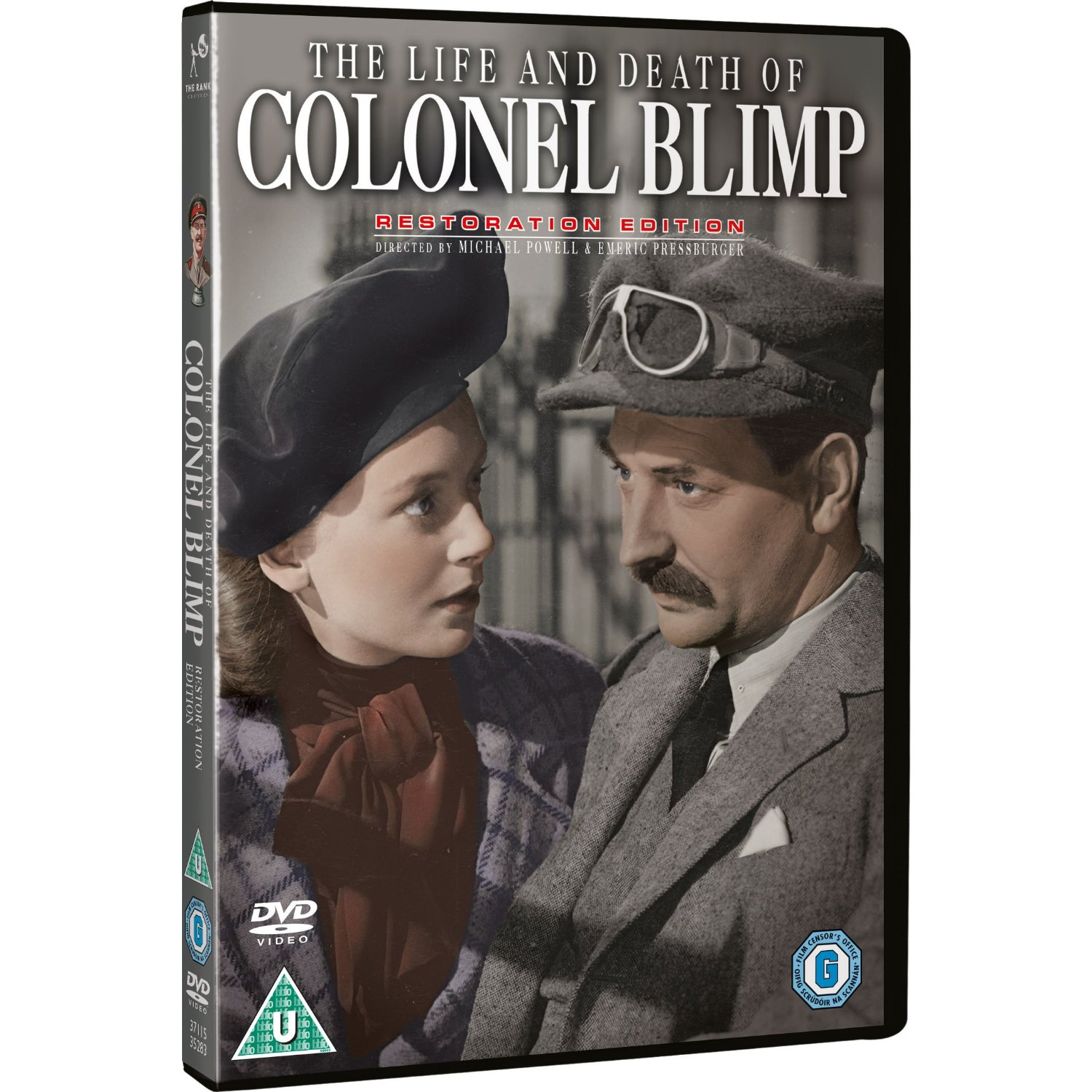
The Life and Death of Colonel Blimp
★ ★ ★ ★ ★

Powell and Pressburger’s 1943 masterpiece arrives in a spanking restored version, ripe for rediscovery if you’re a fan, or demanding to be discovered if you’ve never seen it. The Life and Death of Colonel Blimp is the comedic, romantic and epic story of General Clive Wynne-Candy (Roger Livesey) that kicks off at the height of WWII, before flashing back 40 years to his adventures as a young officer.

In Berlin in 1902 his involvement in a duel with a German officer, Theo (Anton Wolbrook), leads to the pair becoming lifelong friends, even though Theo marries the girl (Deborah Kerr) whom Candy realises too late he’s in love with.

Racing through the First World War and beyond, with Kerr playing three different women in the three timelines, it’s a beautifully observed character piece about a man who refuses to change with the times, who still believes in a war fought by gentlemen.

With its glorious Technicolor photography, ravishing production design and costumes, it’s quite stunning to look at, but that’s just gravy. The range of the wit and humour on offer is remarkable, in a film that can be droll, satirical, farcical and sometimes just plain silly. Colourful characters blustering about can give it the air of a farce, but while it can work as an indictment of colonial warmongering and military incompetence, this isn’t dwelt upon.

At its heart, it’s about the friendship between Candy and Theo. Initially it may seem like it’s setting up characters like Candy to be objects of ridicule, full of pomposity and elitism. In fact it becomes evident that Powell and Pressburger have nothing but admiration and empathy for him, and for decent Germans tainted by Nazism.

It’s sweeping yet intimate and for a near three-hour film, it moves at a fair old lick, anchored by a quite astonishing performance from Livesey, who brings remarkable range, passion and warmth to all the iterations of Candy. Spanning his 20s to his 60s, the combination of makeup and prosthetics used to age him has quite frankly never been bettered.

Video/Audio
Colonel Blimp underwent a painstaking digital restoration recently, and the results are magnificent. Colours pop and detail is fine, and you’re not going to find a better example of a 70 year old film on DVD. Just imagine how good the Blu-ray must look.

Extras
A tasteful doc that looks like it probably dates from the mid 90s (judging by how slim Stephen Fry is) takes us through the production of the film in insightful detail, with contributions from Pressburger’s grandson Kevin Macdonald and cinematographer Jack Cardiff, as well as various well informed historians. There’s also a fine restoration piece hosted by Martin Scorsese that shows how the manky old print was cleaned up frame by frame, and text biographies of all the main players.